
Your Body's Balance System Is Quietly Falling Apart — Here's How to Fix It at Home
Picture this: your mom is standing in the kitchen, reaching for a coffee mug on a shelf that's maybe six inches too high, and for one weird half-second her whole body does that tiny wobble thing — the one where her hand shoots out to grab the counter and you both pretend it didn't happen. She laughs it off. You laugh it off. Nobody says the scary word out loud.
But here's the thing about balance: it doesn't announce itself when it leaves. It just… drifts away, quietly, like a roommate who stops doing dishes and you don't notice until the sink is a biohazard. According to the Centers for Disease Control and Prevention, falls send roughly 300,000 older Americans to the hospital each year with hip fractures — and in 2019, a staggering 83% of hip fracture deaths started with a fall. Women account for about 70% of those hip fractures. These aren't abstract statistics. These are kitchen-mug moments that went wrong.
So I went down a research rabbit hole — CDC guidelines, randomized controlled trials, meta-analyses, the whole Otago Exercise Program situation — and what I found is actually kind of reassuring: you can train your way into a significantly less fall-prone body, mostly at home, mostly with boring exercises that work. Let me walk you through the mental model, the exercises, the programs, and when you need to stop DIY-ing and call a physical therapist.
Why Falls Are the Sneaky Boss Fight of Aging
Think of your body as running three overlapping systems: strength (can your legs actually hold you up?), balance (can your brain-body partnership react fast enough when something goes sideways?), and environment (are there throw rugs trying to murder you?). Most fall-prevention advice only talks about one of these. That's like fighting a boss with one hand tied behind your back and a banana peel under your other foot.
The evidence on exercise is surprisingly consistent. A 2024 systematic review published in JAMA analyzed 37 randomized controlled trials with over 16,000 participants and found exercise interventions reduced falls by 15%, cut individual fall risk by 8%, and reduced injurious falls by 16%. Harms were rare — mostly minor muscle soreness. The authors put it plainly: exercise demonstrated the most consistent statistically significant benefit across multiple fall-related outcomes. That's not wellness-influencer fluff. That's math.
And when you combine exercise with home safety fixes and clinical screening? Multifactorial interventions reduced falls by another 16%. So exercise isn't the whole game — but it's the part you can actually start this week.
Five Balance Exercises to Start Today (With Progressions)
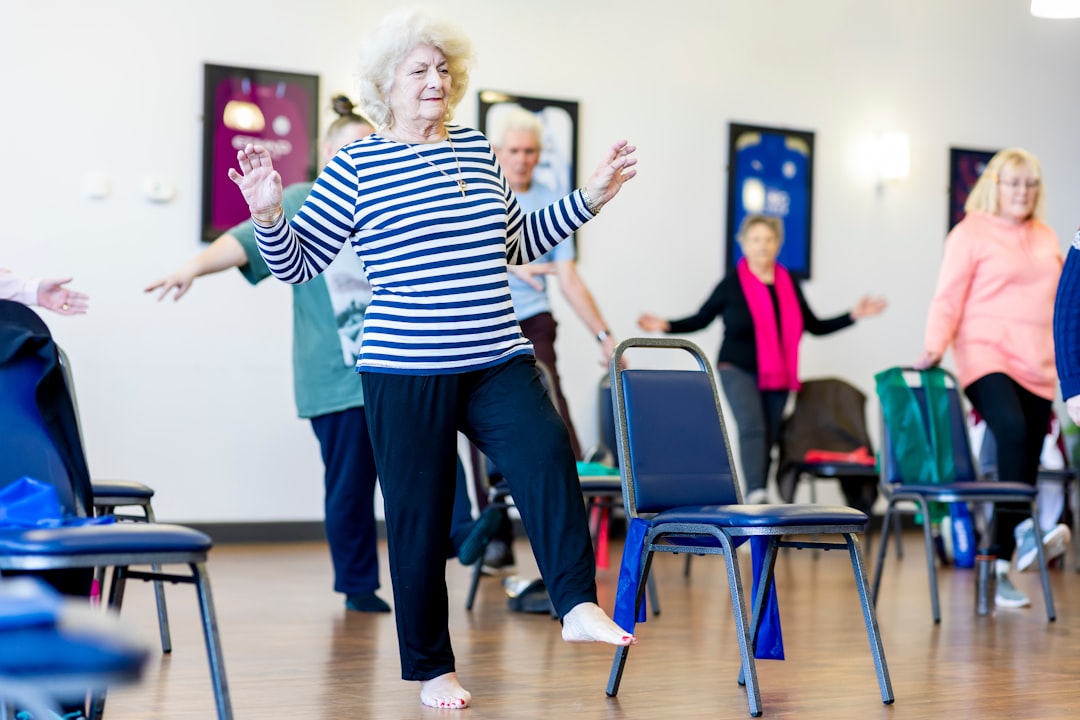
According to Harvard Health Publishing, even one minute of balance work at a time adds up. Physical therapist Kristina Dunlea put it perfectly: just a minute here or there has a cumulative effect — as your balance improves, daily functions get easier. You don't need a gym. You need a wall, a sturdy chair, and the willingness to look slightly ridiculous for 30 seconds.
1. Sit-to-Stands
Stand up from a chair without using your hands. Sit back down. Repeat 5–10 times. Progression: lower chair height, add a light weight, or pause halfway down for three seconds. This builds the quad and glute power you need for stairs, toilets, and car seats — i.e., the entire infrastructure of independent life.
2. Heel Raises
Hold the counter, rise onto your toes, lower slowly. Do 10–15 reps. Progression: one hand on counter, then no hands, then single-leg raises. Your calves are underrated anti-fall equipment.
3. Tandem Standing
Place one foot directly in front of the other, heel touching toe, like you're on a tightrope. Hold 10–30 seconds. Switch feet. Progression: close your eyes (only if you're near something solid to grab). The CDC's physical activity guidelines for older adults specifically recommend heel-to-toe walking and standing from sitting as weekly balance activities.
4. Single-Leg Stance
Stand on one foot for up to 30 seconds. Use a wall or chair if needed — no heroics. Progression: add head turns, or stand on a soft surface like a folded towel. This is the exercise that most directly trains your body to recover when it wobbles.
5. Heel-Toe Walking
Walk in a straight line placing heel directly in front of toe, like a sobriety test but voluntary. Go forward 10 steps, then backward if you feel steady. Progression: increase speed, add turns. Walking backward is explicitly listed by the CDC as a balance activity that helps prevent bone fractures.
How often? The CDC recommends balance activities weekly at minimum. For real fall-prevention benefit, aim for 3 sessions per week, 10–30 minutes each. You can split them into tiny chunks — balance while brushing teeth, during TV commercials, waiting for coffee. The cumulative effect is real.
Strength Training Builds a Fall-Proof Body
Can strength training actually prevent falls in the elderly? Yes — and the mechanism isn't complicated. Falls happen when your muscles can't react fast enough or generate enough force to catch you. Stronger legs, hips, and core give you a bigger margin of error before you hit the floor.
The CDC says adults 65 and older should do muscle-strengthening activities on 2 or more days per week, working all major muscle groups: legs, hips, back, abdomen, chest, shoulders, and arms. Aim for 8–12 repetitions per exercise, at least 1 set; 2–3 sets give more benefit. A systematic review in Life found lower-limb strength improved 15–35% across intervention types, with multimodal strength-balance training reducing falls by 20–45%.
Key muscle groups to target at home:
- Quadriceps and glutes — sit-to-stands, mini-squats, step-ups on a low stair
- Calves — heel raises (your ankle stability depends on these)
- Hip abductors — side-lying leg lifts or resistance-band walks (weak hips = wobbly gait)
- Core — seated marches, standing trunk rotations (balance is a whole-body conversation)
Use resistance bands, light dumbbells, or even water bottles. The CDC's fall prevention page is blunt about it: do exercises that make your legs stronger and improve your balance. Tai Chi is a good example of this kind of exercise — which brings us to the slow-motion martial art your skeptical uncle might actually enjoy.
The Otago Program: 17 Exercises That Cut Falls by 35%
Okay, so what is the Otago Exercise Program? Imagine a physical therapist handing you a personalized playlist of 17 strength and balance exercises, then checking in over the year to crank up the difficulty as you get stronger. That's Otago in a nutshell.
Developed in New Zealand and validated through four randomized controlled trials involving 1,016 participants aged 65 to 97, the program decreased falls and fall-related injuries in high-risk older adults by 46%, according to the UNC School of Medicine's Otago guidance statement. The CDC Compendium of Effective Fall Interventions puts the overall fall-rate reduction at 35% among participants compared with those who didn't take part — equally effective for men and women, with the biggest wins among adults 80 and older who had already fallen in the previous year.
Overall, the fall rate was reduced by 35% among program participants compared with those who did not take part. The program was equally effective for men and women.
The protocol: progressively challenging strength and balance exercises up to 3 times per week for up to 30 minutes, plus a walking program up to 3 times per week for up to 30 minutes. Ankle weights are used for select exercises. You don't have to do all 17 on day one — you start where you are and level up. Ideally, a trained instructor guides the first few home visits, but many of the core exercises (sit-to-stand, knee bends, one-leg stand, heel-toe walking) are things you can begin independently if you're low-risk.
Tai Chi, Home Safety, and the Complete Plan
Is tai chi effective for fall prevention? The data says yes — convincingly. A meta-analysis of 24 randomized controlled trials published in PMC found Tai Chi reduced fall risk by 24% (RR 0.76), improved the Timed Up and Go test by 0.69 seconds, and increased functional reach by 2.69 cm. It works for healthy older adults and high-risk individuals alike, and benefits increase with duration and frequency — exercising 2–3 times per week beats once weekly. Yang-style Tai Chi outperformed Sun-style in the analysis.
Tai Chi is an effective exercise for preventing falls and improving balance ability in older adults, whether they are healthy or at high risk of falling.
But exercise alone is half the picture. How can you help an elderly parent avoid falling at home? Run a home safety audit:
- Remove throw rugs or tape them down flat
- Install grab bars in bathrooms and good lighting on stairs
- Clear clutter from walkways — yes, including that stack of mail
- Get annual eye exams (the CDC recommends this explicitly)
- Ask about osteoporosis screening — 88% of hip fracture ER visits and hospitalizations were caused by falls
- Review medications with a doctor; some cause dizziness
Combine the home fixes with 150 minutes of moderate aerobic activity per week (per CDC guidelines — think brisk walking), 2+ days of strength work, and weekly balance training. That's the complete fall-prevention stack: environment + strength + balance + medical screening. The LiFE program, another CDC-listed intervention, reduced falls by 31% and made participants 46% less likely to fall and 67% less likely to suffer a fall-related injury — by weaving exercise into daily life rather than treating it as a separate chore.
When to Stop DIY-ing and See a Physical Therapist
Harvard Health is clear: older adults with existing balance problems should work with a physical therapist before attempting exercises independently. That's not cautious bureaucracy — it's the difference between training your balance and practicing falling.
Call a PT or doctor if you or your parent has:
- Fallen twice or more in the past year
- Difficulty walking or regularly holding furniture while moving through the house
- Dizziness, numbness, or vision changes
- Fear of falling that limits daily activities (this itself increases fall risk — it's a vicious loop)
- Recent hospitalization or a neurological condition like Parkinson's or stroke history
The Otago Program was originally designed for delivery through home visits by a trained instructor — four or five sessions over the first weeks, then phone check-ins for up to a year. If you're high-risk, that supervised start isn't optional luxury; it's how the 35–46% fall reductions were actually achieved.
The Bottom Line (Before We Both Go Wobble Off Into the Sunset)
Falls aren't an inevitable tax on getting older. They're a predictable outcome of declining strength, eroding balance, and environments full of trip hazards — which means they're also a solvable problem with a pretty decent evidence base behind it. Start with five balance exercises today. Add strength work twice a week. Consider Tai Chi if you want something that doesn't feel like homework. Look into the Otago Program if you're high-risk. Fix the damn throw rugs.
Your future self — or your parent's future self — standing in that kitchen reaching for a mug without the wobble? That's the whole point. Not immortality. Just fewer trips to the emergency room and more years of opening your own damn coffee cabinet. Which, when you zoom out, is actually a pretty huge deal.